

Introduction
In the industrial equipment market, the term "source manufacturer" has become a common selling point. For manufacturers looking to purchase a dry finishing machine, however, the real risk is not simply paying a higher price. The bigger risk is discovering after delivery that the finishing process cannot be replicated, the machine structure is unstable, or there is no reliable support for finishing media, process parameters, and maintenance.
A low-cost machine can become expensive if it leads to repeated trials, inconsistent surface quality, production downtime, or delayed orders.
Therefore, when evaluating a dry finishing machine manufacturer, buyers should look beyond factory photos, machine prices, and advertised specifications. A truly capable manufacturer should be able to connect workpiece analysis, machine design, finishing media, process development, manufacturing, testing, and after-sales support into one complete delivery system.
Real source-manufacturer capability is not about selling a machine at the lowest price. It is about reducing the customer's process trial-and-error cost.
01 | Reframing "Source Manufacturer": It Is About Responsibility for Results
Many buyers still judge whether a company is a manufacturer by asking simple questions such as:
Does the company have its own factory?
Does it assemble the machines in-house?
How large is the production facility?
Is the machine cheaper than competing equipment?
These factors can provide useful information, but they do not fully demonstrate manufacturing capability.
A dry finishing machine is not simply a combination of a motor, working chamber, transmission system, and control cabinet. Machine structure, movement pattern, working capacity, finishing media, workpiece geometry, and processing parameters all affect the final result.
A mistake in any one of these areas can cause a major difference between sample results and mass-production performance.
A reliable manufacturer should therefore be capable of taking responsibility for the complete finishing result. This means understanding:
Which workpieces are suitable for dry finishing
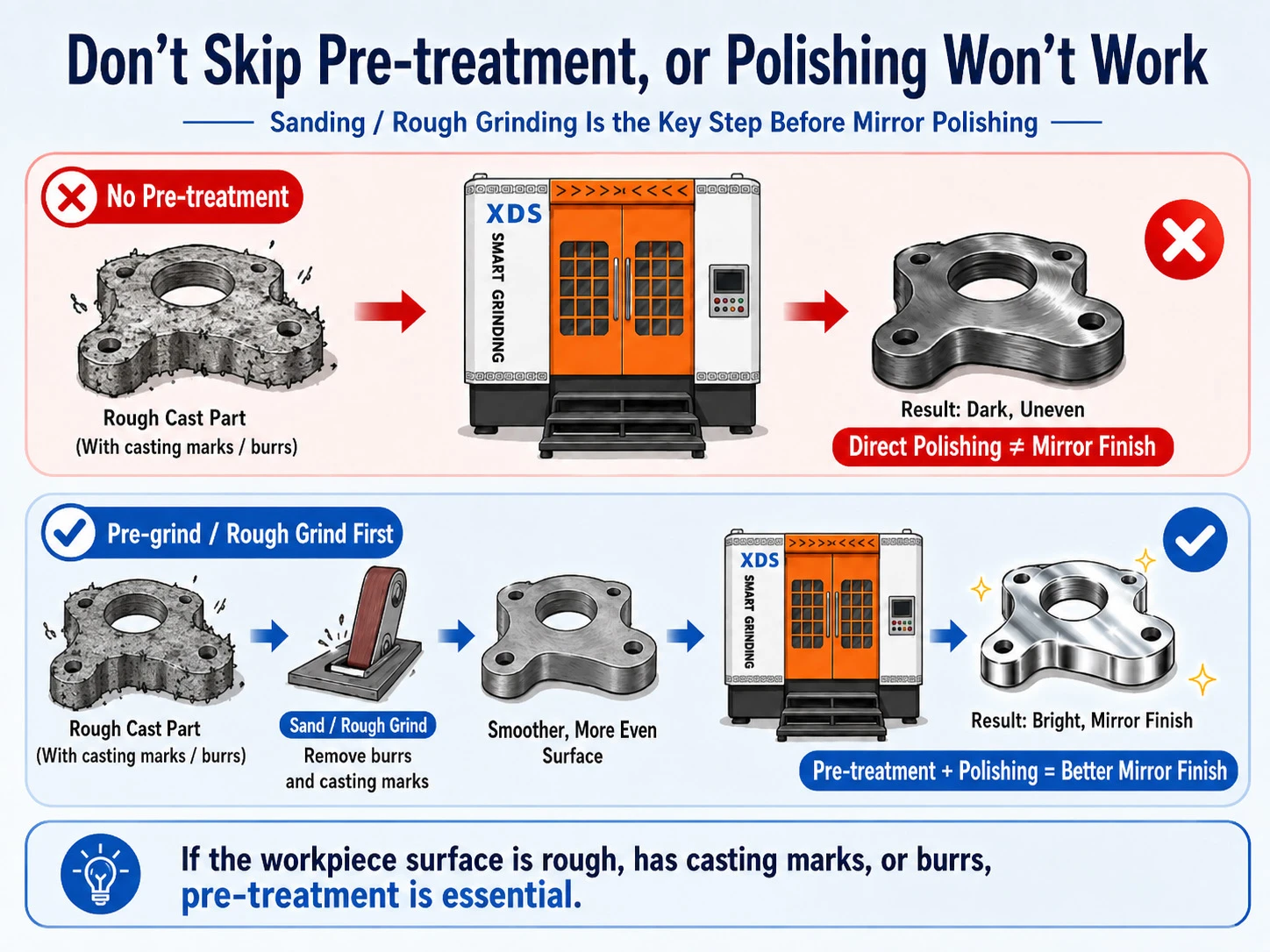
When pre-treatment or rough finishing is required
How to select appropriate finishing media
How to match media, loading, speed, and processing time
Why a particular machine structure is designed in a certain way
Which components determine long-term machine stability
How to troubleshoot problems when finishing results change
In other words, "source manufacturer" should not simply be a self-proclaimed identity. It should be demonstrated through the ability to identify problems, trace their causes, and provide practical solutions.
02 | Process Expertise: Understanding Process Limits Is More Important Than Claiming "Everything Can Be Finished"
Surface finishing does not have one universal set of parameters.
Stainless steel, aluminum alloys, zinc alloys, copper alloys, titanium alloys, and other materials have different hardness, ductility, surface conditions, and processing characteristics.
Workpiece geometry also matters. Thin-wall components, irregular parts, deep-hole components, precision parts, and small hardware may face completely different risks related to impact, deformation, dead zones, and media separation.
A manufacturer that simply claims that its dry polishing machine can process almost any product may not necessarily have strong process expertise.
A professional manufacturer starts with the workpiece, not the machine.
Before recommending equipment, it should understand:
Workpiece material
Part dimensions and weight
Product geometry
Original surface condition
Burr condition
Required surface roughness
Required appearance
Daily production volume
Allowable dimensional change
Whether parts are sensitive to impact or deformation
Real sample testing can then determine the appropriate combination of machine, media, loading ratio, processing time, and operating parameters.
More importantly, a professional supplier should clearly explain what a dry finishing process cannot achieve by itself.
Some parts may require rough deburring before finishing. Others may need multiple stages such as rough finishing, intermediate finishing, and final polishing to achieve the required surface quality.
Process Evaluation Flow: From Understanding the Workpiece to Reproducing Results
1. Confirm Material & Geometry
Understand the material, dimensions, weight, shape, and structural characteristics of the workpiece.
2. Analyze Initial Surface Condition
Identify burrs, machining marks, oxidation, casting defects, or other surface conditions.
3. Define the Finishing Target
Determine the required deburring level, surface roughness, appearance, edge condition, or polishing result.
4. Conduct Real Sample Testing
Use actual customer workpieces to verify machine and media combinations.
5. Establish Parameters & Media Selection
Optimize loading, media type, processing time, speed, and other process variables.
6. Verify Batch Consistency
Confirm whether the process can deliver stable and repeatable results during production.
The ability to explain process limitations is often a stronger sign of technical expertise than simply claiming unlimited applications.
03 | Manufacturing Foundation: Controlling Critical Components Determines Long-Term Stability
A machine that runs smoothly without load in a showroom does not necessarily mean it can operate reliably under heavy load and continuous production.
For a dry finishing machine, factors such as:
Frame rigidity
Shaft alignment
Transmission matching
Working chamber structure
Inner lining material
Bearing configuration
Lubrication
Electrical control
Safety protection
can all influence long-term performance.
If a supplier only performs basic assembly while critical components and structural elements depend on temporary outsourcing and inconsistent integration, machine consistency, maintenance efficiency, and future upgrades can become difficult to guarantee.
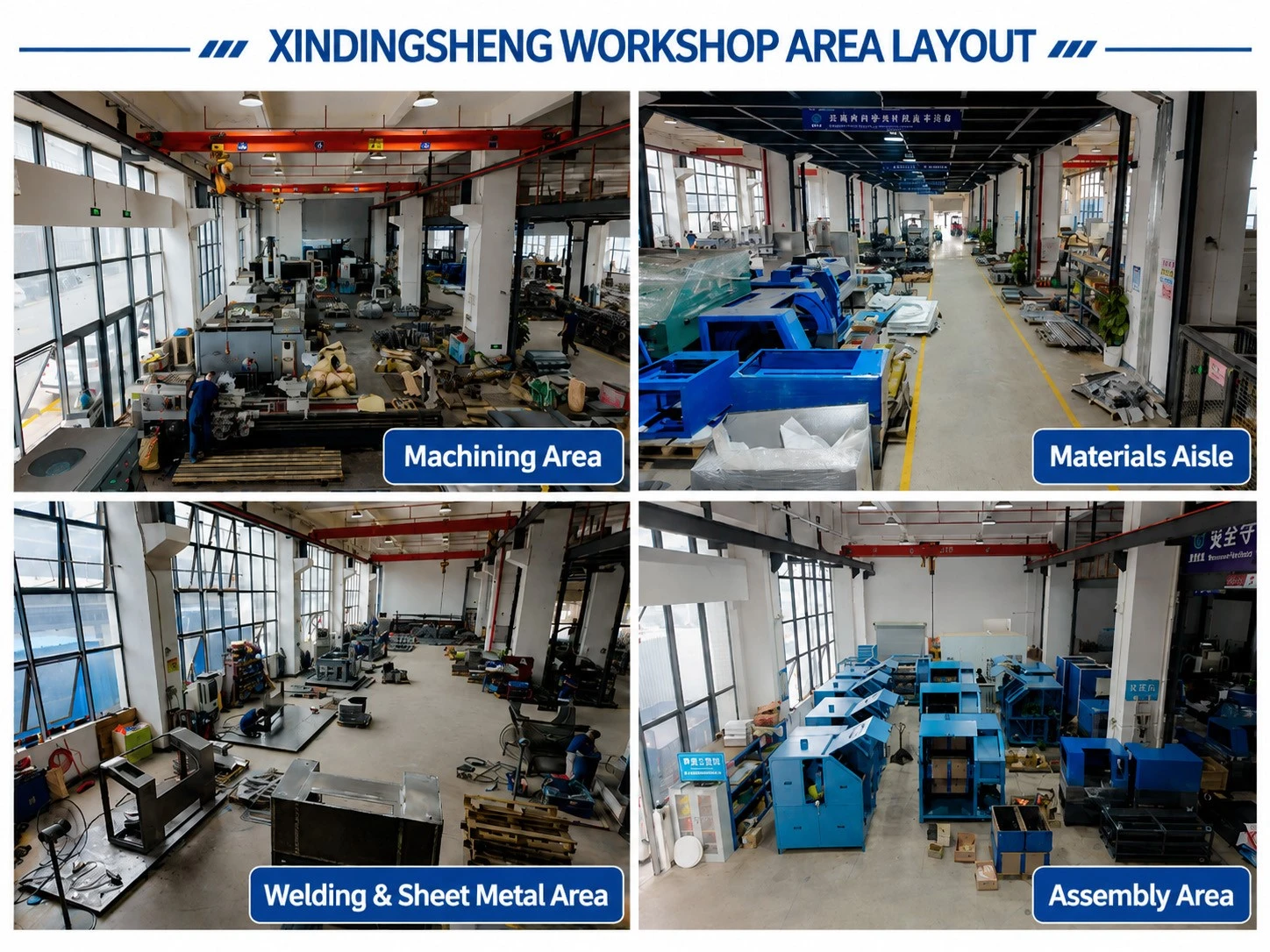
When evaluating manufacturing capability, buyers should go beyond the finished-machine area.
It is more useful to inspect:
Machining processes
Welding operations
Assembly procedures
Quality inspection
Electrical control integration
Machine commissioning
Load testing
The key question is not whether every single component is manufactured internally.
The more important question is whether the critical variables affecting machine performance and service life are under effective control.
Core Manufacturing Capabilities
◆ Critical Structural Machining
Precision control of the frame, shaft, transmission components, and mounting surfaces helps reduce deviations during long-term operation.
◆ Material & Component Selection
Structural materials, electrical components, inner linings, bearings, and other parts should be selected according to actual loads and operating conditions.
◆ Assembly & Safety Control
Standardized assembly, lubrication, guarding, emergency stop functions, and protection systems help reduce operational risks.
◆ Complete Machine Load Testing
Testing under realistic operating conditions helps evaluate vibration, temperature rise, noise, transmission stability, and continuous operating performance.
Being able to assemble one machine proves that production activity exists. Being able to repeatedly deliver machines with consistent performance proves that a manufacturing system exists.
A strong manufacturer should also have sufficient delivery resilience. Standard machines and customized equipment should be produced according to schedule, common spare parts should be available, and the machine structure should be designed with practical maintenance in mind.
04 | Evidence-Based Verification: Look at the Complete Production Evidence Chain
During equipment purchasing, buyers are often attracted by individual specifications such as maximum speed, maximum capacity, or claimed polishing performance.
However, these numbers do not automatically translate into production efficiency.
A higher operating speed, for example, does not always mean faster or better finishing. Excessive speed may increase impact, surface damage, heat generation, or finishing media consumption.
The real question is:
Can the machine convert its specifications into stable, qualified output for your actual workpieces?
Four-Step Verification Method
Step 1 | Visit the Factory
Inspect whether machining, welding, assembly, inspection, and commissioning processes are actually carried out in an organized production environment.
Step 2 | Test Your Own Workpieces
Use your actual products to evaluate finishing quality, processing time, impact risk, dimensional changes, and pre-treatment requirements.
Step 3 | Observe Loaded Operation
Pay attention to vibration, temperature rise, noise, loading and unloading efficiency, transmission stability, and safety protection.
Step 4 | Verify Similar Applications
Review customer applications involving similar materials, part structures, finishing requirements, and production volumes.
A complete evaluation should also include the total cost of ownership.
The purchase price is only one part of the cost. Buyers should also consider:
Labor requirements
Finishing media consumption
Energy consumption
Rework
Downtime
Spare parts
Maintenance
Process adjustment
Production consistency
A cheaper machine may ultimately cost more if it requires frequent parameter adjustments, repairs, manual re-polishing, or repeated process trials.
Samples, production data, application cases, and long-term operating results are more reliable evidence than marketing claims alone.
05 | Complete Service: Machine Delivery Is Only the Beginning
For a dry finishing process, results can change as workpieces, media condition, environmental temperature, production volume, and operating methods change.
When a customer introduces a new product, increases production capacity, or requires a higher surface finish standard, existing parameters may need to be re-evaluated.
Therefore, complete manufacturer support should not end when the machine is installed.
A professional dry finishing machine supplier should provide support covering:
Process development
Machine installation
Operator training
Finishing media selection
Parameter setup
Preventive maintenance
Spare parts
Troubleshooting
Process optimization
New-product introduction
At XDS Finishing, we believe that reliable surface finishing requires more than equipment alone.
Our approach combines:
Machine + Finishing Media + Process Expertise + Technical Support
Before delivery, real workpiece testing helps reduce equipment selection risks.
During installation and commissioning, machine operation, process parameters, and operator training are established.
After production begins, customers can continue to receive support for finishing media selection, original spare parts, maintenance, troubleshooting, and process optimization.
This complete approach helps customers move from equipment purchase to stable production.
The Real Value of a Source Manufacturer
For industrial buyers, choosing a source manufacturer should not simply mean finding the lowest equipment price.
The real value lies in reducing uncertainty throughout the entire production cycle.
From One-Time Equipment Purchase to Long-Term Production Support
◆ Real Sample Testing
Reduces equipment selection and process development risks.
◆ Established Process Parameters
Makes finishing results easier to reproduce during production.
◆ Controlled Manufacturing
Helps maintain machine reliability and operating consistency.
◆ Reliable Media & Spare Parts Supply
Supports continuous production and easier maintenance.
◆ Responsive Technical Support
Helps reduce downtime when problems occur.
◆ Continued New-Product Support
Makes it easier to introduce new workpieces and finishing requirements.
Conclusion: Look at Process, Manufacturing, Data, Service, and Long-Term Value
A dry finishing machine source manufacturer should not be defined by a marketing slogan.
It should represent a complete and verifiable capability to:
Understand the workpiece → Develop the finishing process → Control critical manufacturing → Test the machine → Support mass production
For buyers, the best way to evaluate a manufacturer is to consider the factory, actual workpiece samples, production data, application cases, and after-sales support as one complete evidence chain.
At XDS Finishing, we believe the future competition in surface finishing equipment will not be determined by machine specifications alone.
It will increasingly depend on the combined capability of:
Equipment + Finishing Media + Process Technology + Complete Technical Support
A truly reliable finishing equipment partner should help customers reduce trial-and-error, improve production consistency, minimize downtime, and build a stable surface finishing process that can support long-term manufacturing.
See the process. Verify the manufacturing. Test the data. Evaluate the service. Calculate the long-term value.
That is what real source-manufacturer capability should mean.


