

If you machine brass or copper parts - plumbing fittings, lock cylinders, electrical terminals, decorative hardware - you already know the frustration: the metal is soft, scratches appear no matter how careful you are, wet polishing leaves water stains, and parts always end up bumping into each other in the barrel.
In our latest factory demonstration, a batch of copper components went from machined finish to true mirror gloss in a divided dry polishing machine - with every part polished separately in its own compartment. Here is exactly how it works, and why this setup has become our go-to recommendation for soft non-ferrous metals.
Soft metals fail in ordinary tumbling for three reasons:
Part-to-part impact. Brass is softer than steel media. When parts collide at barrel speed, they leave impact dents and black marks that no polishing compound can remove afterwards.
Water staining. Wet processes leave droplet marks and can trigger oxidation on copper alloys within hours.
Media embedment. Aggressive ceramic media cuts too fast on soft metal and embeds particles in the surface, dulling the finish.
The Divided Dry Polishing Machine Solves All Three
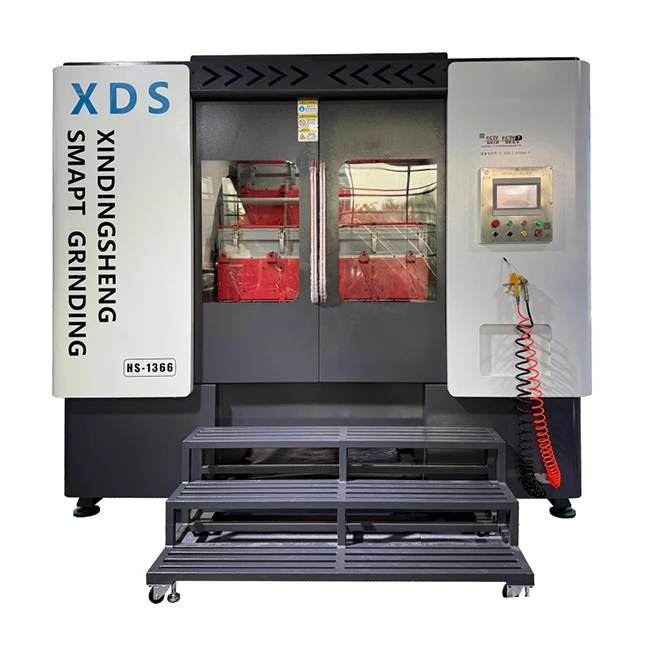
A divided dry polishing machine uses removable partition plates to split one work barrel into individual compartments. Each compartment holds one batch - so parts never touch each other, no matter how small.
Key design features:
Removable partitions, zero fixture cost. Adjust compartment size in minutes to match the workpiece - from tiny lock pins to larger fittings. No custom fixtures to order.
Dry process, no water stains. The machine runs with dry polishing media (walnut shell grit, corn cob abrasive) plus a brass/copper polishing compound - no water, no droplet marks, no flash oxidation.
Gentle, uniform pressure. Low-speed rotation lets the media rub, not hammer, the surface - ideal for soft alloys.
Automatic lubrication and self-maintenance. The drive system oils itself, which is a big part of why the machine is engineered for around ten years of service life.
One-button mirror finish. Store your process recipe on the touch panel; recall it for every batch with consistent results.
Recommended Starting Recipe for Brass/Copper Mirror Finishing
(Adjust after a sample test - we run this free of charge with your parts.)
| Parameter | Starting point |
|---|---|
| Media | Walnut shell grit or corn cob abrasive, fine grade |
| Compound | Copper/brass brightening polishing compound, 2–3% by media weight |
| Loading | Parts + media at ~1:3, compartments filled 50–60% |
| Cycle | 30–60 min per batch |
| Result | Machine finish → satin → mirror gloss, Ra ≤ 0.1 μm achievable |
Real Applications from Our Workshop
Copper lock cylinders and lock parts - deburr and brighten in one step, batch after batch identical
Brass plumbing fittings and valves - mirror gloss ready for plating or direct sale
Luxury car key shells - 8K-class mirror finish on zinc alloy and brass shells
Jewelry and smart wearable hardware - scratch-free separated polishing
Large workpieces - for oversized parts, see our 680-series dry polishing machine with open compartments
FAQ
Can it polish mixed sizes in one run?
Yes. Different compartments can hold different parts, so one cycle covers your full product mix.
Will it remove heavy burrs on copper?
Heavy burrs should come off first (or run a longer coarse-media cycle). The divided dry machine excels at deburring light burrs plus final mirror brightening.
Is it suitable for export-grade surface requirements?
Our machines are EU CE certified and ISO 9001 manufactured; the process is widely used for export hardware in Europe and North America.
Try It With Your Own Parts
Send us your brass or copper samples. We run a free pre-production polishing test, record the process parameters, and quote the right machine configuration - typically within 24 hours.
Dongguan Xindingsheng Intelligent Grinding Technology Co., Ltd. - intelligent grinding equipment since 2008. ISO 9001 · EU CE · 60+ patents.


