

In the metal surface treatment industry, polishing machines are core equipment for workpiece deburring, chamfering and mirror finishing. Many operators assume higher speed always means better polishing, yet they overlook that rotational speed is the soul parameter of polishing technology. It directly determines material removal rate, surface roughness, workpiece thermal damage and abrasive consumption. It is also the key technical control point of high-end equipment such as the dry glazing machine from Xindingsheng Intelligent Grinding Technology. Combined with industry principles and the technical advantages of Xindingsheng equipment, this article deeply analyzes the underlying logic and application value of polishing speed.
1. Underlying Principle of Rotational Speed
The material removal rule of polishing follows the classic Preston Equation:MRR = K·P·V(Material Removal Rate = Constant × Polishing Pressure × Relative Speed)
With constant pressure, rotational speed (which determines relative speed V) is linearly positively correlated with material removal rate. However, this correlation has an effective range and critical threshold rather than unlimited growth.
Low Speed (<1500rpm): Insufficient speed leads to low abrasive cutting frequency and uneven force distribution, resulting in poor efficiency, vibration lines and scratches.
Medium Speed (1200–2500rpm): The golden range for conventional polishing. Abrasive particles fully participate in cutting with uniform force, balancing high-efficiency deburring and surface smoothing while avoiding excessive friction heat accumulation.
High Speed (>2500rpm): Excessively high speed causes sharp heat accumulation, easily leading to surface burning, over-grinding, abrasive splashing and accelerated abrasive loss, resulting in defective workpieces.
In short, speed is not better when higher; it must be precisely matched with material and process - the core design concept of Xindingsheng intelligent grinding equipment.

2. Practical Industry Rule: High Speed for Rough Grinding, Low Speed for Fine Polishing
Metal polishing is divided into three stages: rough polishing, medium polishing and fine polishing. Each stage requires completely different speed settings, following the industry golden rule: High speed for rough grinding, low speed for fine polishing. The intelligent speed regulation system of Xindingsheng dry glazing machine is developed based on this principle.
Rough Polishing: High Speed for Efficient Defect Removal
Goal: Quickly remove burrs, flash, oxide scale and obvious surface scratches.Recommended speed: 2000–3000rpm with coarse-grain abrasives.Suitable materials: Carbon steel, stainless steel and other hard metals.
Xindingsheng Advantage: The dry glazing machine adopts heavy-duty cutting design and high-power drive. With bidirectional revolution and rotation adjustment, it removes large-area defects efficiently, 3–8 times faster than manual polishing.
Medium Polishing: Medium Speed for Balanced Efficiency & Smoothness
Goal: Eliminate rough polishing traces and lay a foundation for mirror finishing.Recommended speed: 1500–2000rpm, 20%–30% lower than rough polishing.Suitable materials: Aluminum alloy, zinc alloy and pre-polished hard metal workpieces.
Xindingsheng Advantage: Built-in PLC intelligent control supports one-click storage of dedicated medium-polishing parameters, ensuring uniform friction and stable reduction of surface roughness.
Fine Polishing: Low Speed for Mirror Effect
Goal: Reduce surface roughness to Ra≤0.02 and achieve 8K mirror finish.Recommended speed: 800–1200rpm with fine abrasives and high-lubrication glazing oil.Taboo: High speed in fine polishing causes thermal burning, blackening and irreversible micro scratches.
Xindingsheng Advantage: Dedicated low-speed precision grinding mode fits curved workpieces without dead angles, achieving mass mirror finishing with a yield rate over 98%.
Recommended Speed by Material
| Workpiece Material | Rough Polishing (rpm) | Fine Polishing (rpm) | Key Notes |
|---|---|---|---|
| Stainless Steel | 2200–2800 | 1000–1200 | Avoid surface burning |
| Aluminum Alloy | 1800–2200 | 800–1000 | Prevent deformation |
| Copper/Brass | 1500–2000 | 800–1000 | Avoid micro scratches |
| Titanium Alloy | 2000–2500 | 1000–1200 | Anti-oxidation & high temperature resistance |
3. Xindingsheng Dry Glazing Machine: Intelligent Speed Regulation Redefines Polishing Standards
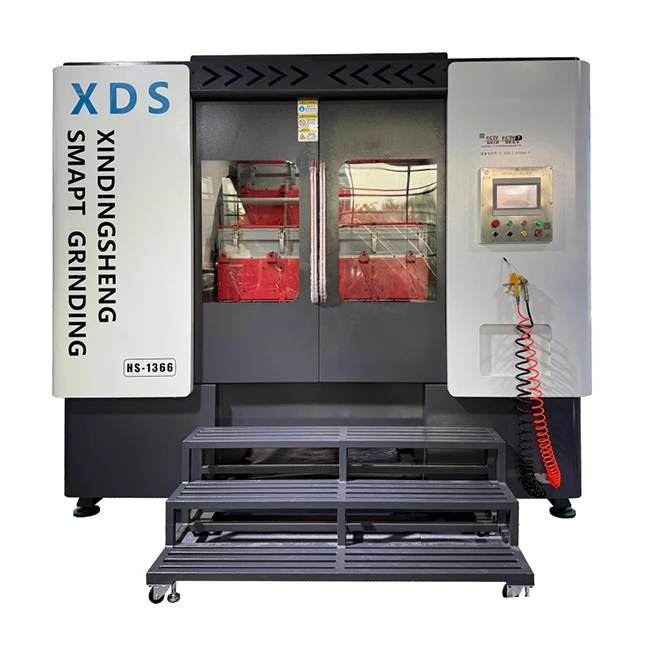
Traditional polishing machines mostly adopt fixed or simple adjustable speed, unable to adapt to diverse materials and processes. Xindingsheng Dry Glazing Machine takes precise speed control as the core, integrating intelligent technology and eco-friendly craftsmanship to solve industry pain points.
1. Full-range Stepless Speed Regulation
Equipped with imported variable-frequency motor and PLC intelligent control system, speed is adjustable steplessly from 500rpm to 3000rpm, covering all rough, medium and fine polishing processes. Custom speed parameters are available for different workpieces.
2. Independent Revolution & Rotation Adjustment
Revolution and rotation speed are independently adjustable. Abrasive dissipates heat fully during operation to avoid local overheating and extend abrasive service life by over 30%. Ideal for special-shaped parts and precision small components with all-round dead-angle-free grinding.
3. Intelligent Process Storage & Stable Quality
Multiple sets of process parameters (speed, time, rotation direction) can be stored and recalled with one click, eliminating manual adjustment errors. Built-in workpiece drop monitoring stops the machine automatically to avoid batch defective products.
4. Eco-friendly Dry Grinding Technology
Different from traditional wet polishing, Xindingsheng dry glazing machine applies water-free physical grinding. No wastewater discharge; dust concentration is lower than 5mg/m³, meeting strict environmental standards. It saves washing and drying procedures, shortening production cycle by 50% and reducing comprehensive cost by over 30%.
4. Common Speed Regulation Misunderstandings in the Industry
Higher speed equals better polishingFact: Excessively high speed causes burning, deformation and fast abrasive loss; matched speed for each process is the optimal choice.
Unified speed for all workpiecesFact: Hard metals need higher speed for efficiency; soft alloys require lower speed to prevent deformation and scratches.
Speed adjustment is unnecessary for fine polishingFact: Low-speed fine grinding with fine abrasives is indispensable to eliminate micro scratches and reach mirror-grade surface finish.
5. Conclusion: Speed Dominates, Intelligence Leads the New Polishing Trend
Polishing machine rotational speed is far more than simple fast-slow adjustment; it is the core technical parameter that determines grinding quality, efficiency and production cost. From Preston Equation theory to the practical rule of high speed for rough grinding, low speed for fine polishing, and to the intelligent speed control technology of Xindingsheng dry glazing machine, the industry upgrade always focuses on precise speed regulation.
As a leading enterprise in intelligent grinding technology, Xindingsheng Intelligent Grinding Technology deeply focuses on dry polishing technology. With intelligent speed regulation, high efficiency and stable equipment performance, it helps hardware, 3C, auto parts and medical device industries upgrade polishing craftsmanship. In the future, refined speed control, intelligent operation and eco-friendly processing will become the inevitable development trend of the metal surface treatment industry.
Get In Touch With Us
I warmly welcome your letters or calls. If you have anything to discuss, please feel free to let me know.


